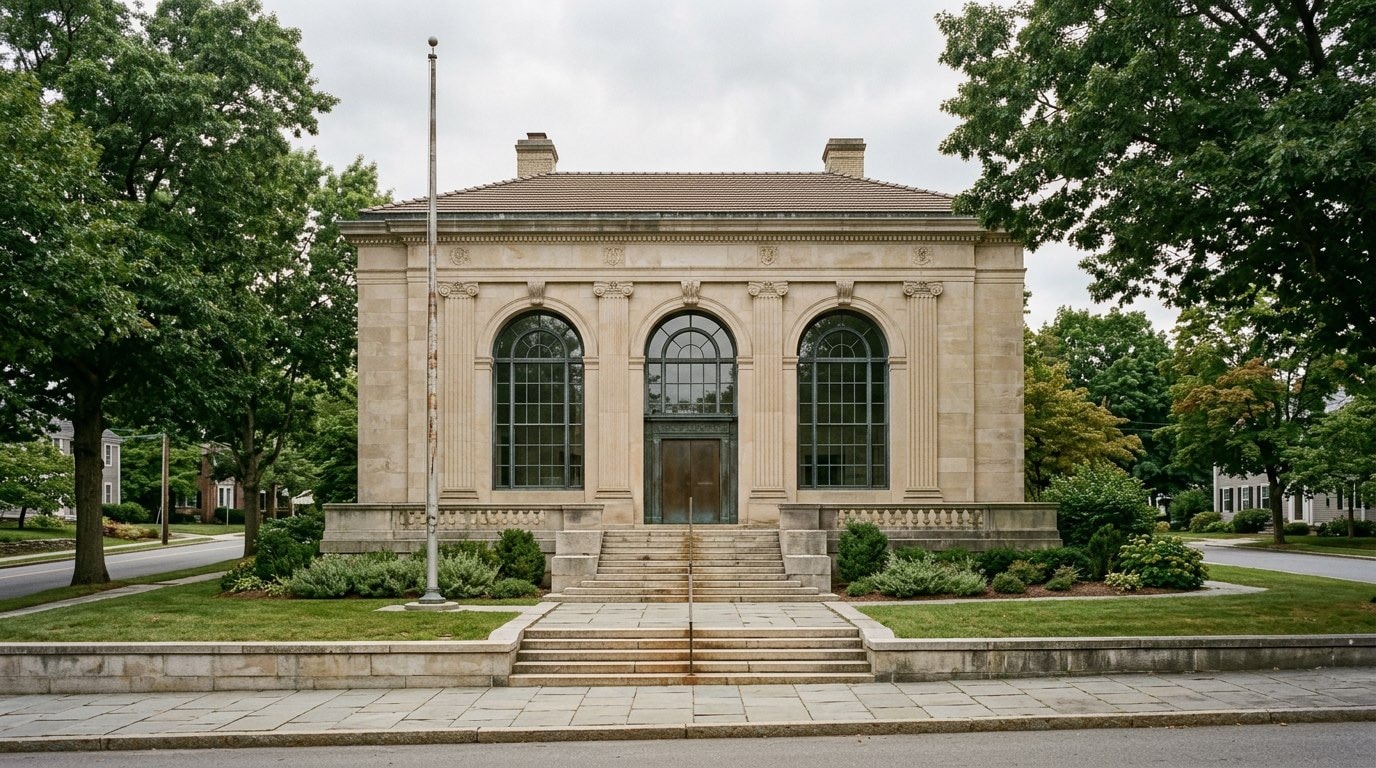
A library is a service, not a structure — but in a small city the structure does a great deal of the remembering. Four buildings in Milledgeville, plus a lakeside branch and a neighbourhood facility, carried public library service in Baldwin County across nine decades. This page is about those buildings and what each of them made possible.
This page deliberately carries no street addresses, telephone numbers or opening hours. Library service in the county continues today under a different administrative arrangement; anything operational belongs to the operating library, not to this site.
The Elks Building on Hancock Street, 1938
The first home was borrowed. A local property owner offered a vacant building he owned on Hancock Street — the Elks Building — and helped with the renovation that turned a lodge hall into a reading room. The library opened there on 18 January 1938.
Lodge halls make surprisingly workable first libraries. They have one large public room, a solid street presence, a front door people already know how to find, and no fixed internal partitions. What they do not have is load-bearing floor plans designed for the weight of books, quiet corners, or any capacity for growth. Fifteen years was as long as it lasted.
The Veterans' Building, 1953
The second move was funded by cashing in bonds and put the library on the first floor of the Veterans' Building. This is the least-documented of the homes and appears in the record mainly as a bridge — the place the collection lived while the institution pursued something more durable.
It is a familiar mid-century pattern. Across the American South in the 1950s, county libraries frequently occupied a floor of a civic or fraternal building: visible, central, rent-light, and permanently one shelving unit away from full.
The old post office, 1961
The third home was the county's decommissioned post office, secured for the library in 1961 through the intervention of Congressman Carl Vinson. On 15 June 1961 the Board of Trustees renamed the headquarters the Mary Vinson Memorial Library, in honour of Vinson's late wife.
Repurposed post offices are among the best adaptive reuses a small-town library can hope for. Early- and mid-century federal post offices were built with generous public lobbies, high ceilings, good natural light, heavy floors and a monumental civic front — a specification that translates almost directly into a reading room. Hundreds of American libraries occupy one, and the pattern is well documented in the Library of Congress architectural survey collections.
The 1987 building
By the 1980s circulation had outgrown the post office. After a period of competing proposals, a purpose-built library was agreed: 18,900 square feet over two storeys, opened in 1987, and still the headquarters building today.
The 1987 plan did something none of the adapted buildings could. It separated the collection by audience, giving distinct areas to children, to young adults and to local history. The local history room upstairs became the county's working research space — the subject of the genealogy research page — and the children's area meant that a storytime no longer had to interrupt someone's afternoon with a newspaper.
It is the first building on this list designed around what a library actually does rather than around what a previous occupant did.
The Lake Sinclair branch, 2003
Two years after the system became independent, on 30 May 2003, it opened a branch to serve the north side of town and the households strung along Lake Sinclair's shoreline. This is a geography problem more than a population problem: a reservoir puts water where a road would be, and a fifteen-minute drive on a map can be forty minutes in practice.
The branch ran shorter, later weekday hours than headquarters through most of its documented history — the profile of a service designed to catch people on the way home rather than during a working day.
The 2008 neighbourhood facility
On 10 October 2008 the system opened a third facility inside a housing authority building. This one is worth dwelling on, because it is the least architecturally interesting and the most strategically pointed of all of them.
Putting a library service point inside housing removes every barrier at once: transport, distance, cost, unfamiliarity, and the quiet social friction of walking into a grand downtown building. It is an unglamorous, high-impact form of outreach, and the fact that a small county system did it in 2008 says something about how the institution understood its 1948 commitment to serve "the people — adult and juvenile — of this county."
A further branch on Hancock Street appears in the later years of the record, returning service to the same street where it all began in 1938 — a coincidence, but a pleasing one.
Reading the buildings as a sequence
Set out in order, the sequence tells the institutional story better than any narrative: borrowed room, borrowed floor, repurposed federal building, purpose-built library, then outward into the county by branch. Each step is a response to a specific pressure — space, then permanence, then reach.
For the decisions behind the moves, see the history. For the governance body that made them, see how library boards worked.