The library system's own page on this began with a sentence worth keeping: "We know that conducting genealogical research can be a bit intimidating." That is the correct opening for the subject, and it is why local history rooms exist. This page describes what such a room held, why Middle Georgia is a particular kind of research problem, and where the same material can now be reached online.
This is a research guide. No research service is offered here; historical request forms, telephone extensions and the name of a volunteer specialist are omitted.
The local history room
When the purpose-built library opened in 1987 it included, for the first time, a dedicated local history area — on the upper floor, separate from the general collection. Historical records describe a volunteer local history specialist keeping regular afternoon hours there several days a week, available to help with research specific to the area.
That model — a volunteer subject expert with fixed hours in a dedicated room — is extremely common in American county libraries and is often the single most valuable service in the building. The expertise is local, unwritten and irreplaceable: which families changed the spelling of a surname and when, which years of a county record series are missing, which cemetery is on private land.
Under a later regional arrangement, the same function continued, with a genealogical and historical room and access to a Middle Georgia archives collection.
What a Middle Georgia local history collection holds
The standard components include:
- Newspapers on microfilm — the county paper, often running back to the nineteenth century. Obituaries, marriage notices, court reports, land sales, and the social columns that place a family in a place on a date.
- County record abstracts — wills, deeds, estate inventories, tax digests, marriage books, court minutes. Usually as published abstracts and indexes rather than originals.
- Census material — federal census schedules with local indexes.
- Cemetery surveys — often compiled by volunteers or a local society, and frequently the only record of burials that predate or postdate formal registration.
- Church and school records — where congregations and boards deposited them.
- Family files — the vertical files: donated research, correspondence, photocopies, unpublished typescripts. Idiosyncratic, uncatalogued and often the thing that breaks a wall.
- Maps and plats — land lot maps in particular, which in Georgia are essential.
- Local histories and yearbooks — including material published by historical societies and by the institutions themselves.
Why Georgia research has its own rules
Two features make Georgia genealogy distinctive, and both bite hard in this part of the state.
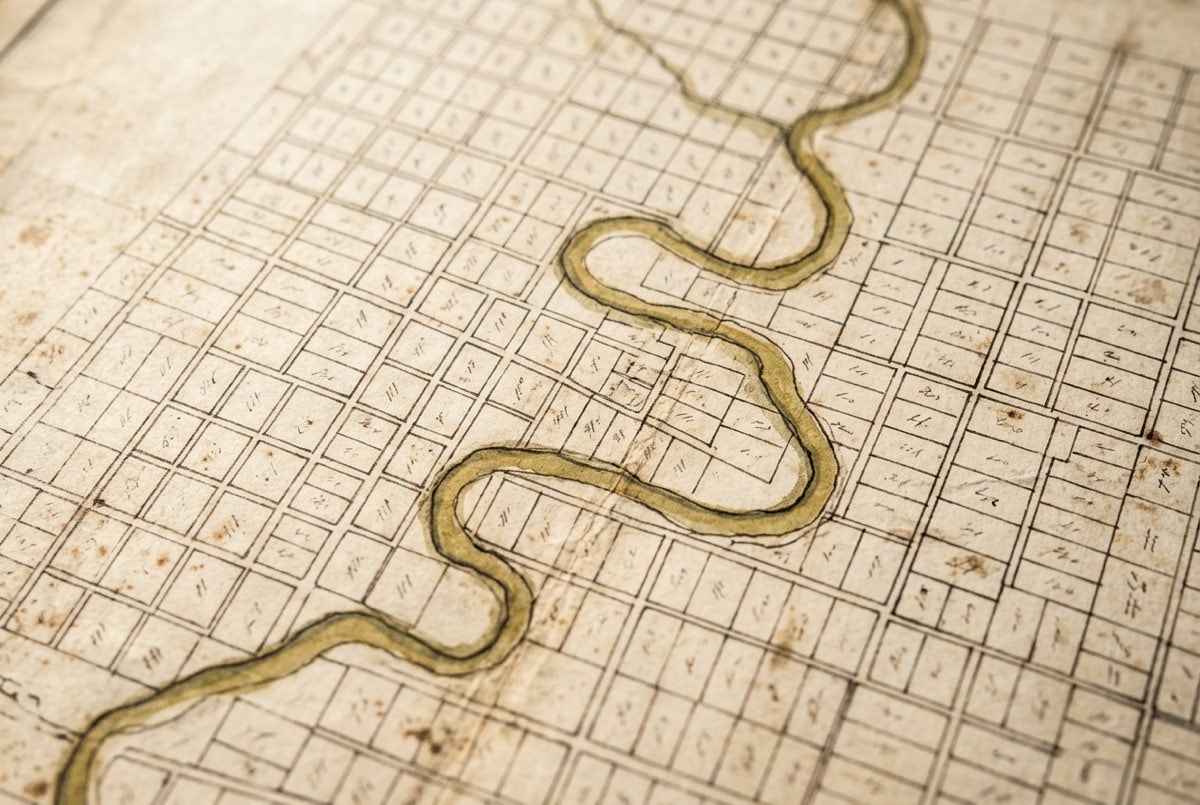
Land lot surveys. Georgia distributed much of its land through lotteries and surveyed it into numbered land lots within numbered districts, rather than by the metes-and-bounds descriptions used further east. Once you understand the system it is a gift: a land lot number is a fixed, mappable, searchable coordinate that ties a family to a precise piece of ground across generations.
County proliferation. Georgia has more counties than any state except Texas, and their boundaries moved repeatedly through the nineteenth century. A family that never left its farm can appear in three different counties' records across sixty years because the county lines walked past them. Baldwin County itself was created in 1803 and subsequently gave up territory to neighbouring counties. If a record is missing, check the parent county before concluding it was lost. This single point resolves more Georgia dead ends than any other.
Milledgeville's particular archive problem
Milledgeville was Georgia's capital from 1804 until 1868. That has two consequences for researchers.
The first is enrichment: state-level activity generated records, newspapers, correspondence and printed material about Milledgeville far out of proportion to its size, and much of it is now digitised at state level rather than held locally.
The second is loss. The Civil War and Reconstruction era disrupted record-keeping across the state, and Georgia lost material at both state and county level in ways that are patchily documented. A gap in a series here is not necessarily a filing error.
Where the same material lives online now
A great deal of what once required a trip to a microfilm reader is now free and searchable.
- Georgia Historic Newspapers — full-text searchable scans of Georgia papers, including Middle Georgia titles. Start here. Searching an unusual surname across a whole county paper is the fastest breakthrough available to a Georgia researcher.
- Digital Library of Georgia — photographs, manuscripts, maps, government records and county collections contributed by institutions statewide. Free and open.
- Georgia Archives — the state archive: land records, county record microfilm, colonial and state government series, and finding aids that tell you what survives before you travel.
- National Archives — census, military service and pension, and federal land records.
- New Georgia Encyclopedia — reliable edited background on counties, towns, institutions and events, which is how you avoid building a family narrative on a misdated local legend.
Commercial subscription databases cover much of the same ground and are frequently available free inside a public library building. Which ones a given library licenses changes annually.
A practical order of work
For a Middle Georgia line, the sequence that wastes the least time is roughly: establish the family in the census first and get the county right for each decade; check whether the county boundary moved during that span; search the digitised newspapers for the surname across the whole period; then move to land, probate and marriage records for the correct county; and only then approach a local history room — with specific questions, specific dates and a list of what you have already ruled out.
Local history volunteers and archivists can do extraordinary things with a precise question and very little with "I'm researching my family." That is not gatekeeping; it is simply how finding aids work.
See also local history of the Lake Country and the research links directory.