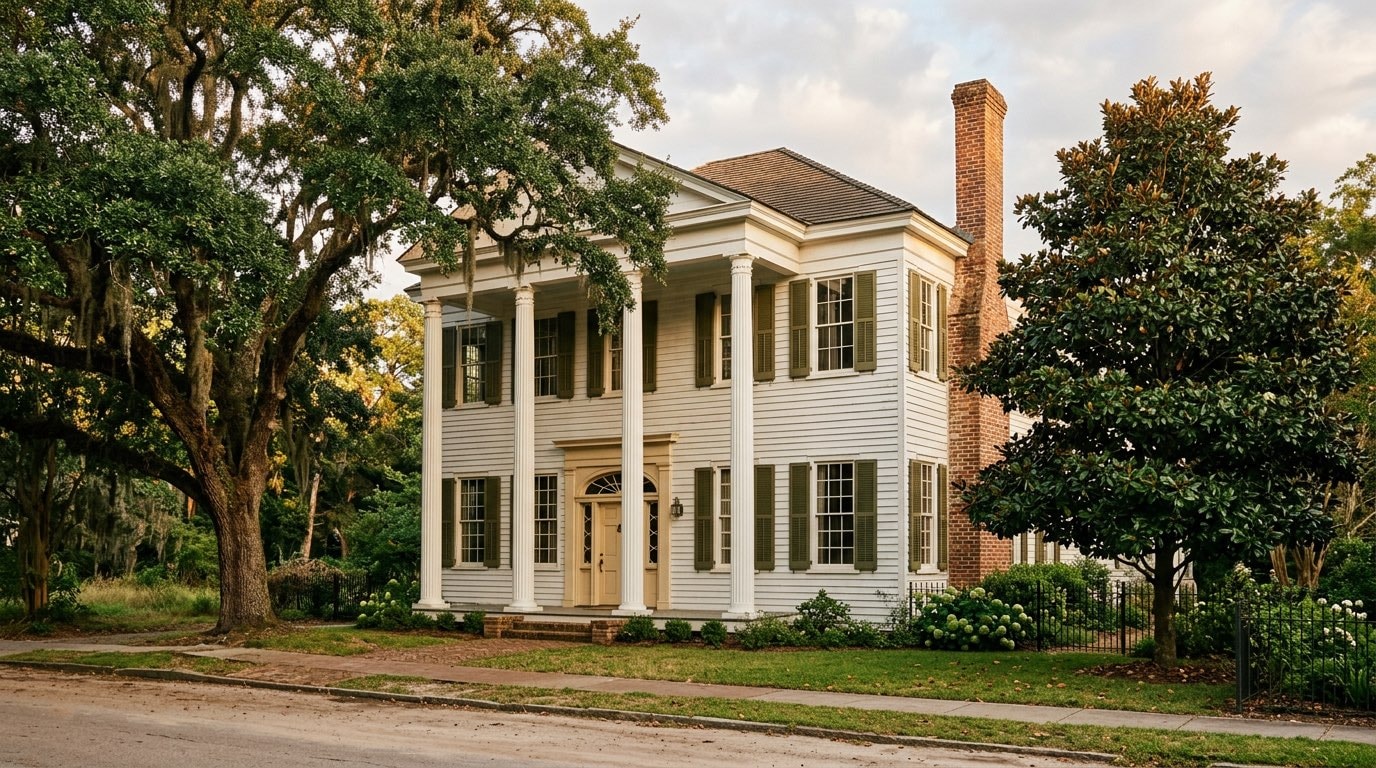
A local history collection is shaped by the place it serves. This one had an unusually dense place to cover: a former state capital, a nineteenth-century state hospital campus, a literary landmark, two universities, two enormous reservoirs and a rural county that has been continuously farmed since the early 1800s. This page sketches the subject matter — the standing local-history topics that a Middle Georgia reference collection had to answer questions about.
The Old Capital
Milledgeville was laid out at the start of the nineteenth century as a purpose-built seat of government and served as the capital of Georgia from 1804 until 1868, when the seat moved to Atlanta. That is more than sixty years of a small inland town being the political centre of the state.
Purpose-built capitals leave distinctive physical evidence: a planned grid, oversized public squares, a governor's residence, and a stock of substantial early-nineteenth-century houses built for legislators who needed somewhere to stay when the assembly sat. Milledgeville retains a good deal of that fabric, which is why the town's built environment is disproportionately significant for its size. The New Georgia Encyclopedia carries reliable edited background on the town and the period.
The capital era also means that for six decades, state records, state newspapers and state political correspondence were generated here — a fact that shapes where a researcher should look, as discussed on the genealogy research page.
Two lakes and the shape of the county
The "Twin Lakes" of the library system's name are the two reservoirs that dominate the modern county: Lake Sinclair and Lake Oconee, both impoundments of the Oconee River created for hydroelectric power in the twentieth century.
Reservoirs rewrite a county. They put water over farmland, roads, homesteads, mills, churches and burial grounds; they create hundreds of miles of new shoreline and, with it, a new pattern of settlement that is seasonal, dispersed and largely unconnected to the historic town. Anyone doing property or family research in a reservoir county eventually runs into the flooding: a place that appears in an 1890s record may not exist as land any more.
For a library, the lakes created the service problem that produced a branch on the north side of town — described on the buildings page.
The state hospital
Baldwin County was for a long time the site of one of the largest psychiatric institutions in the United States, established in the mid-nineteenth century and operating for well over a century and a half. At its peak it housed a population in the thousands and was among the county's largest employers.
This is difficult and important local history. It involves the treatment of vulnerable people across eras with radically different standards; it involves the working lives of generations of local families; it involves burial grounds whose records are incomplete; and it is a subject where the historical record and living memory do not always agree. A local history collection in this county cannot avoid it and should not treat it as a curiosity. Researchers approaching it should expect access restrictions on individual patient records, which exist for good reason.
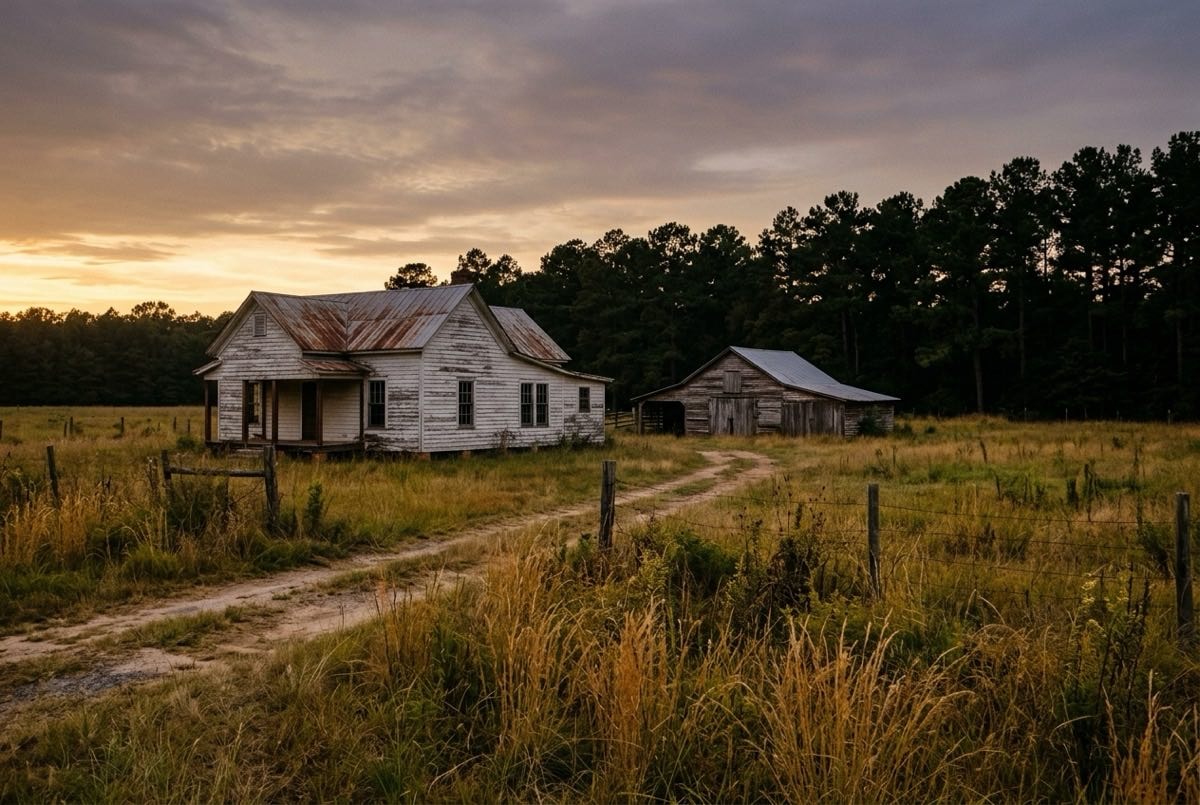
Flannery O'Connor and Andalusia
The novelist and short-story writer Flannery O'Connor (1925–1964) lived and wrote at Andalusia, a farm outside Milledgeville, for the last thirteen years of her life. Most of her mature work — including the stories on which her reputation principally rests — was written there.
The farm survives as a preserved literary site, and it makes Baldwin County a genuine destination in American literary geography. For a public library this is a permanent source of reference questions from students, visitors and researchers, and the library directory listed the property throughout its life. It is one of the few subjects on which a small county library was, inevitably, a specialist.
Higher education
The county hosts a public liberal arts university and a long-established military college, and a technical college campus serves the area as well. Student populations of that scale change a small town's demography, its reading demand and its calendar. They also generate their own archives, which frequently hold local material a public library does not.
Festivals and civic culture
The library directory pointed to the town's arts organisation, its main-street organisation and its festivals — a roots-music festival and a spring festival among them. Local festival records are a genuinely useful and badly under-collected historical source: they document what a community thought was worth celebrating, who organised it, and how that changed decade by decade.
The town wiki
One local-history subject deserves a note of its own. The library system ran a MediaWiki installation as a local encyclopedia for the town, under a portmanteau nickname combining the place name with "encyclopedia" — and external sites linked to it under exactly that name.
A library-hosted community wiki is an idea that deserved to survive better than it generally did. It sits precisely where a public library's mandate and the open web overlap: local knowledge that no commercial publisher will ever collect, gathered by the people who hold it, hosted by the institution whose job is keeping it. Most such projects were quietly retired. That this small system ran one at all is a credit to it.
Where to research these subjects
For all of the above, the free statewide collections listed under research links are the practical starting point — particularly the digitised historic newspapers, which cover the capital era, the reservoir construction and the twentieth-century civic record in one searchable body of text. The Georgia Historical Society holds significant manuscript collections relating to the state's political history.