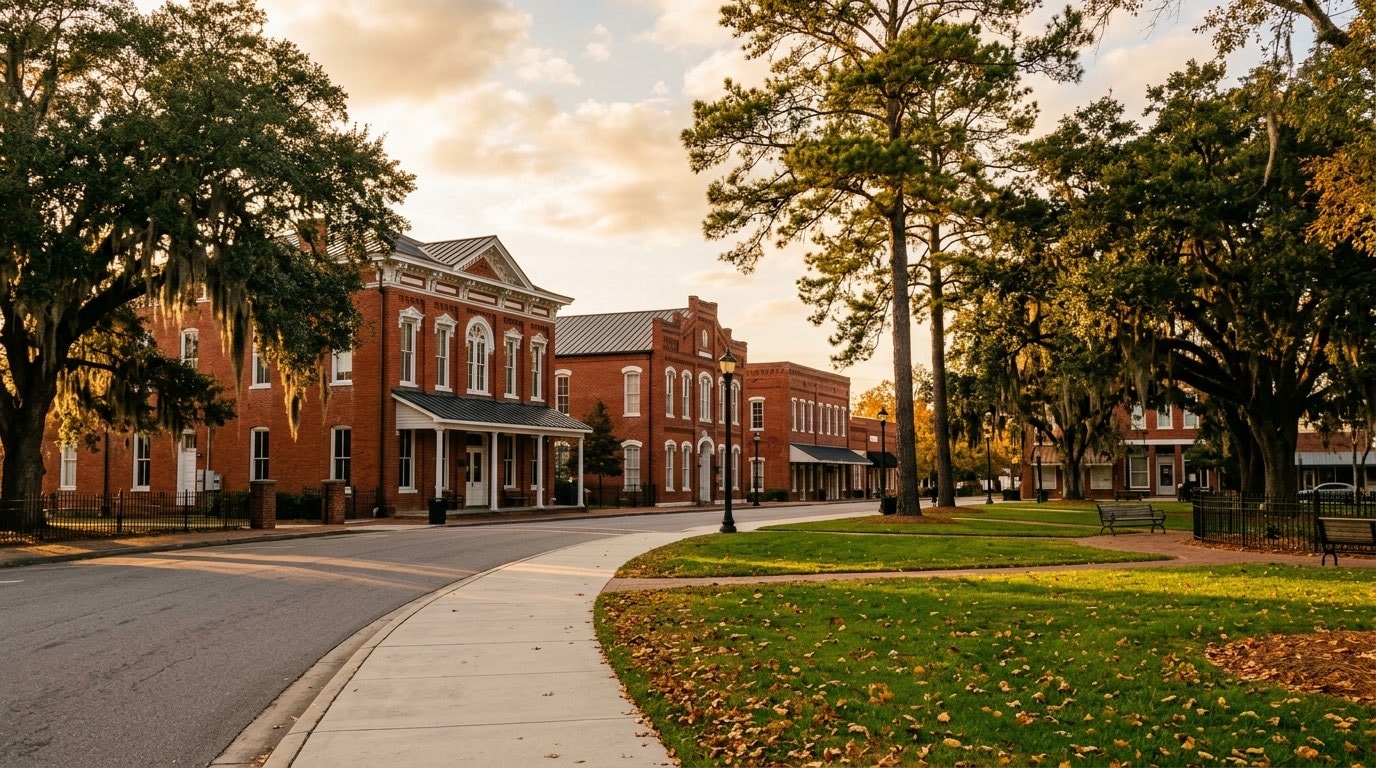
Between two man-made lakes in the middle of Georgia sits a county seat that was once the whole state's capital. Milledgeville and the surrounding Baldwin County countryside have kept a public reading room going, in one building or another, since a January morning in 1938 — and this site is an independent account of that long, ordinary, remarkable civic habit.
This is not a library and it does not provide library services. It is a reference on how public library service took root in Middle Georgia, what a small-city library system actually did with its days, and how the reading culture of the Lake Country — the Library Fair, the summer reading clubs, the local history room, the book sales in the parking lot — was built and sustained by a community rather than by any one institution.
Subjects covered
The material here covers roughly seventeen years of the library system’s documented history, beginning in 2007. That record is unusually good. Small institutions rarely leave a legible paper trail; this one left a detailed one, and it is worth reading.
- The history — how a $25-a-month city appropriation and a borrowed building on Hancock Street became a two-storey library that has outlived four of its own homes.
- The Library Fair — the fourth Saturday in September, from 1981 onward: books, plants, baked goods, a flea market and a raffle, all of it feeding back into children's programming.
- The buildings — an Elks lodge, a veterans' hall, a decommissioned post office, a purpose-built library, and a branch out by the lake.
- Summer reading — the single most durable programme in American public librarianship, and how it ran here.
- Genealogy and local history research — what a Middle Georgia local history room holds, and where the same material lives online now.
- Reading lists and book awards — the Georgia Peach Book Award, statewide reading lists, and how a small library chose what to put on the display table.
Why the Lake Country is a distinctive place to read about libraries
Baldwin County is not a typical library service area. It contains a former state capital with a preserved antebellum street grid, two universities' worth of students, a large state hospital campus with its own complicated history, a substantial rural population, and two enormous reservoirs — Lake Sinclair and Lake Oconee — whose shorelines fill and empty with the seasons. A library system here has to serve year-round residents, term-time students, weekend lake households and people with no transport, all at once, on a county budget.
That tension appears throughout the library's history. A branch was opened out on the north side of town in 2003 specifically to reach lake households. Another opened in 2008 inside a housing authority facility, which is a very deliberate answer to a very specific access problem. The system ran computer classes and loaner programmes long before broadband was universal in the county. None of that is glamorous, and all of it is the actual work.
A note on tense, and on accuracy
Everything on this site about the library organisation itself is written in the past tense. Public library service in Baldwin County continues today under a different administrative arrangement, and that current service is not described here — for anything current, including hours, borrowing and programmes, readers should go to Middle Georgia Regional Library directly. Nothing here should be read as speaking for them.
Each factual claim is grounded in source material. Individual staff members, trustees, volunteers, donors and programme participants are described by role rather than by name, and no child or young person who appeared in the original material is identified here in any form. That is a deliberate editorial rule and it is not negotiable.
Reading Georgia's shared library infrastructure
The documented history makes unusually clear how much of a Georgia public library's capability is not local at all. A card issued in Milledgeville worked at hundreds of other member libraries across the state through PINES, the statewide shared catalogue, and the research databases available at any terminal came through GALILEO, Georgia's virtual library. A county of fifty thousand people had, functionally, the reference collection of a state.
That model — small local buildings sitting on top of large shared systems — is the single most important structural fact about Georgia public libraries, and it is explained in more detail on the borrowing and policy page and in the research links directory.
Where to start
If you have ten minutes, read the history. If you grew up here, read about the Library Fair — the receipts alone are a portrait of a town. If you are researching a family line in Baldwin, Putnam, Hancock or Jones County, start with genealogy and local history research. And if you simply want to know what a working public library system in a small Georgia city actually offered, the programmes page has the fullest inventory.